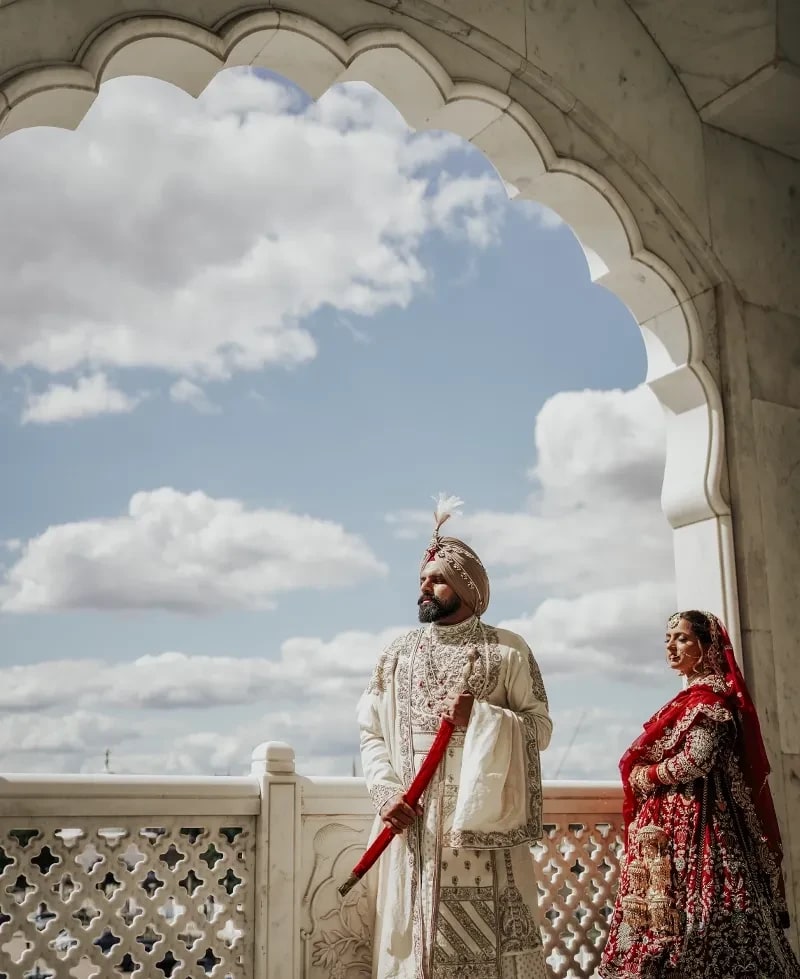
Sikh weddings
Your Anand Karaj, honored on camera.
A crew that knows what is and is not appropriate in a gurdwara, traveling to Sikh couples across the US.
Restraint is the skill
Inside the gurdwara, the quality of the coverage depends mostly on what the crew chooses not to do. The rules there are expressions of respect, and every guest notices when they are broken.
The Guru Granth Sahib stays out of every frame we take. We use no flash and no added light, keep shutters silent during kirtan, and never stand between the couple and the sangat while the laavan are sung. Our cameras stay in fixed positions to the side and the back, with fast lenses doing the work.
Every gurdwara sets its own policy, in the US as much as anywhere. We contact the granthi or the committee well before the wedding, often through your family, and settle positions in advance.
Within those limits there is plenty to film: the milni at the doors, the palla placed in the bride's hand, her brothers and cousins walking with her around the Guru Granth Sahib, karah prasad shared with everyone, and the couple serving in the langar.
Across the wedding weekend
A Sikh wedding weekend is far bigger than the hours spent in the darbar hall.
- 01
Mehndi
Henna, songs and the women of the family running the evening. Filmed as the party it is.
- 02
Sangeet
Bhangra, giddha and family performances, often in a hotel ballroom. Usually the biggest night of the weekend.
- 03
Baraat and milni
The groom's arrival with dhol, and the families greeting each other relative by relative. The first emotional moment of the wedding day.
- 04
Anand Karaj
Hymns from the ragis, the ardas, the palla, then the laavan. Two cameras stay planted on opposite sides for all four rounds.
- 05
Langar
Everyone in the hall receiving karah prasad alike, then the newlyweds helping hand out food. Communal, generous and too often left out of films.
- 06
Reception
Entrances, speeches and a dance floor that rarely empties.
Coverage options
We put two operators on the Anand Karaj as standard, for a reason explained below.
Gurdwara day
- One day
- Two crew for the ceremony
- Baraat, milni, Anand Karaj and langar
- Stills and video from a single team
Gurdwara and reception
- One to two days
- Two crew
- Gurdwara morning, then the evening party
- A single film covering both
Travel and accommodation are itemized separately in your written quote.
Full wedding weekend
- Three to four days
- Two to three crew
- Every event from mehndi night to the reception
- Feature film plus highlights
No round of the laavan can be repeated. Placing one operator on each side protects every round.
We don't publish prices, because no two multi-day weddings are the same. Tell us your date, your city and how many events you are planning, and we will send an itemized quote with nothing to decode.
Twenty-five years in the room
What Sikh families can expect
Before skill with a camera comes respect for the darbar hall.
The Guru Granth Sahib is never filmed
It never appears in our footage, whether framed directly or caught behind the couple. This is the quickest way to tell whether a crew has worked in a gurdwara before.
Silent, natural-light coverage
We bring nothing that flashes, clicks or glows while kirtan is underway. The ragis and the sangat lead the ceremony, and the camera stays in the background.
Both sides of the circle
Both operators stay still and out of the congregation's sightline.
Questions
Before you ask.
Will the gurdwara let you film the ceremony?
In most cases, once permission is given, and always under the rules of that particular gurdwara. Our crew keeps the Guru Granth Sahib out of shot, works without flash and keeps clear of where the sangat is looking. We agree the details with the gurdwara before your wedding.
Will all four laavan be covered from both sides?
Yes. Two stationary operators on opposite sides cover every round, so we never depend on a single angle for the most important part of the ceremony.
Can a drone be part of our coverage?
Not anywhere near the gurdwara itself. Outside, for the baraat or an outdoor reception, we can fly one where the venue and local rules allow it.
Will we need to explain the ceremony to you?
No. We understand that the palla signifies her consent, that the four rounds are what make the marriage, and that the men of her family walk beside her as she circles. That last moment is the one other crews tend to miss.
What if our gurdwara limits photography heavily?
Then we work exactly within its rules, and we learn them well in advance. A properly covered restricted ceremony is far better than an argument at the door.
Inquire
Is your datestill free?
Tell us the date and the venue and we will come back within one business day with availability, a team size and an itemized quote.