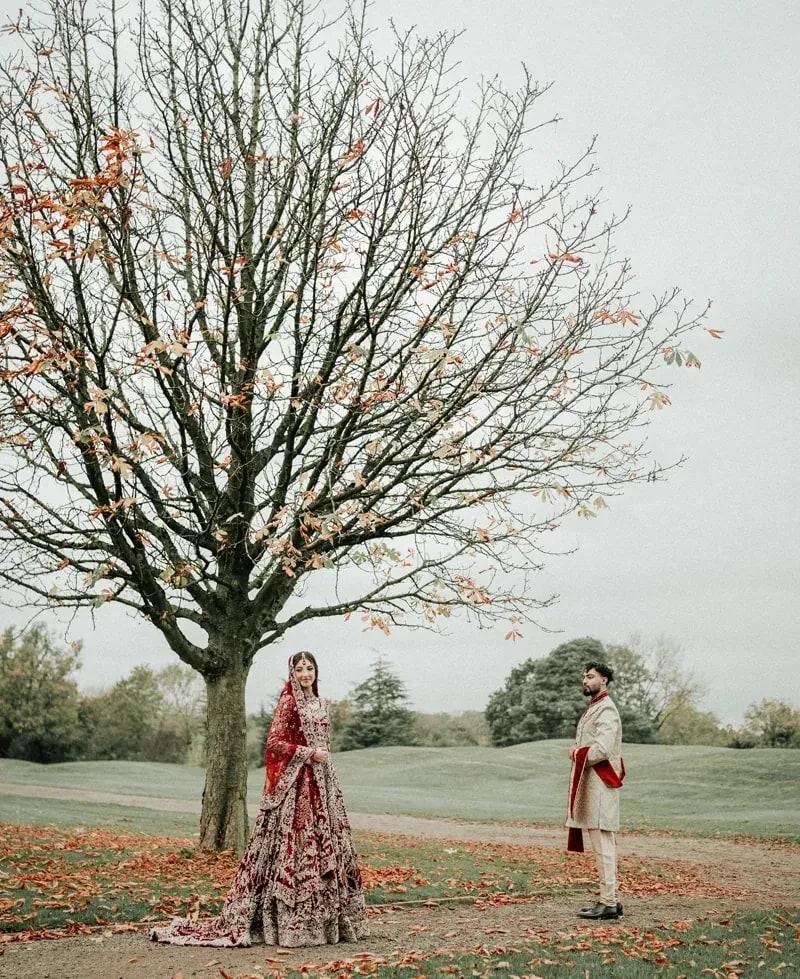
Muslim and Pakistani weddings
From the dholki to the walima, covered with care.
A team that has filmed thousands of Muslim weddings, traveling to couples across the US. We plan around your family's customs and your mosque's rules.
Every event, understood on its own terms
A Pakistani wedding in the US is usually a run of events rather than a single day: dholki nights, a mehndi or mayoun, the baraat, the nikkah and the walima, often over three or four days.
We have filmed for Pakistani, Bangladeshi, Indian Muslim, Arab and Turkish families, and their weddings are not interchangeable. Rather than bringing assumptions from the last one, we ask how your family does things and build the plan from your answer.
The nikkah asks for a completely different approach from everything around it. The ijab-o-qabool is brief and cannot be repeated, so it calls for quiet, distance and long lenses. The mehndi and walima call for the opposite: movement, energy and enough crew to keep up with a full ballroom.
Whether the nikkah takes place at a mosque, at home or in a hotel, we confirm what is permitted ahead of time. Policies on cameras in a prayer space vary widely, and learning them on the morning is how important moments get missed.
The events we cover
Several events, three or four days, delivered as one film.
- 01
Dholki
Evenings of singing around the dhol in the weeks or days before. Informal and full of family, and easy to cover lightly with a small crew.
- 02
Mehndi and mayoun
The turmeric-and-blessings mayoun at home, then the mehndi with henna, choreographed dances and the two sides teasing each other. Colorful, loud and often the best footage of the week.
- 03
Baraat
The groom's arrival with his family, often to dhol in a hotel driveway, and the welcome from the bride's side. One camera travels with the procession while another waits at the entrance.
- 04
Nikkah
The marriage contract, the ijab-o-qabool and the signing of the nikah nama. Filmed from a respectful distance with no flash and no interruptions.
- 05
Rukhsati
The bride's farewell from her family, sometimes with the Quran held above her head. Among the most emotional minutes of the wedding, filmed quietly and from a distance.
- 06
Walima
The reception hosted by the groom's family to announce the marriage. Large guest lists, speeches, stage portraits and a long evening.
Coverage options
Crew size follows the number of events and how many of them overlap.
Nikkah
- One day
- One to two crew
- Nikkah plus the gathering that follows
- Photography, videography or both
Nikkah and walima
- One to two days
- Two crew
- Both events, on the same day or apart
- A single film covering both
Travel and accommodation are itemized separately in your written quote.
Full wedding week
- Three to four days
- Two to three crew
- Pre-wedding nights through to the walima
- Feature-length film plus highlights
When the bride's and groom's mehndi fall on the same night, one team cannot be in both rooms. We staff for that.
We don't publish prices, because no two multi-day weddings are the same. Tell us your date, your city and how many events you are planning, and we will send an itemized quote with nothing to decode.
Twenty-five years in the room
What Muslim families can count on
Twenty-five years of filming, a large share of it nikkahs and walimas.
We know who speaks when
The proposal is put on the bride's behalf, often through her wali, and the groom accepts. Vows are not exchanged. Knowing where the binding words will come from is what puts the camera on the right face.
Mosque policy settled early
Some mosques welcome full coverage, some limit where we stand, some ask that the prayer hall not be filmed at all. We find out in advance and plan to it.
We plan for separate seating
Where men and women sit apart, we staff both sides, including female crew where that matters to you, so nobody has to move for a camera.
Questions
Before you ask.
Do you specialize in Pakistani weddings?
We have filmed a great many Pakistani weddings. We know the dholki, the mehndi rivalry between the two sides, the baraat, the nikkah, the rukhsati and the walima, and we plan coverage around each of them for US couples too.
Will our mosque allow filming?
Usually, within that mosque's rules. Some allow full coverage, others restrict flash or positions, and some ask that the prayer space stay off camera. We contact them beforehand and plan around their answer.
Can we have a female photographer or videographer?
Yes. Where the bride's side, the women's seating or the getting-ready room calls for it, we can include female crew. Mention it in your inquiry so we can confirm female crew for your dates and plan the team around it.
Our wedding moves between a home, a hall and a hotel over four days.
That is the norm for the weddings we film. We plan the full schedule in advance, including how the crew and equipment move between a home, a banquet hall and a hotel without losing time.
A few relatives are uncomfortable on camera.
We hear this often. Let us know beforehand and we will focus the coverage on the couple and close family, and keep those guests out of frame.
What length of film should we expect?
For a full multi-day wedding, expect a feature of roughly twenty to twenty-five minutes plus a shorter highlight film. A nikkah on its own is shorter.
Inquire
Is your datestill free?
Tell us the date and the venue and we will come back within one business day with availability, a team size and an itemized quote.