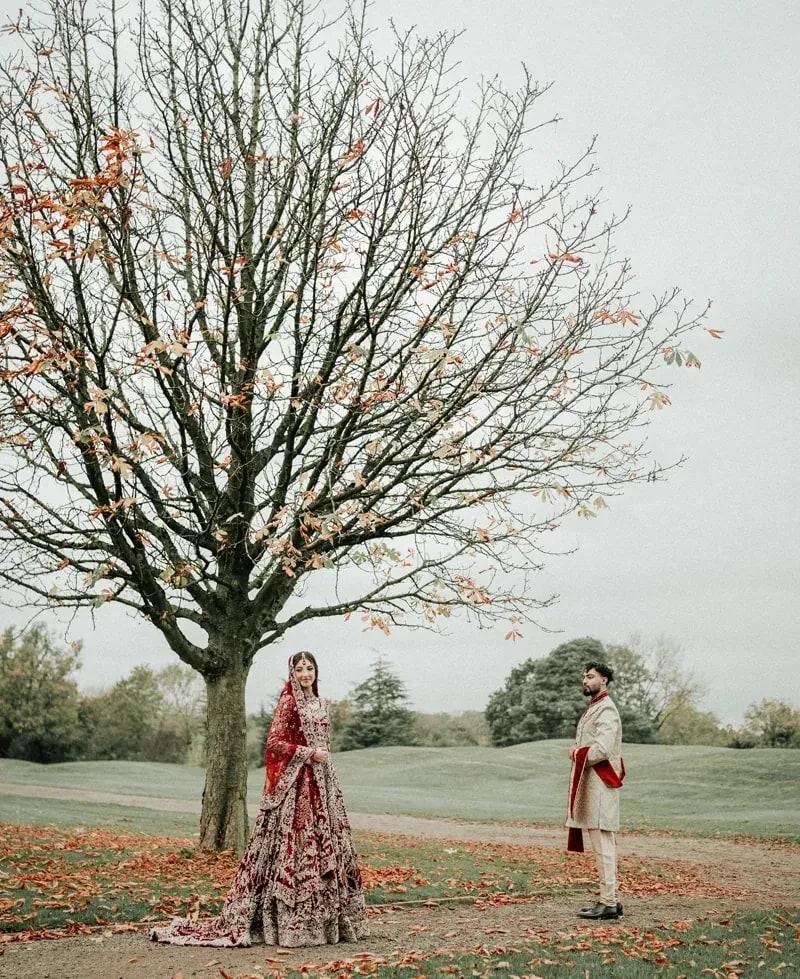
Nikkah
Filming the Nikkah since 2000, now traveling to Muslim weddings across the United States.
The work
Every wedding we film is shot, cut and graded in house, no sub-contracted crews, no stock transitions.
The Muslim wedding
At the center of a Muslim wedding is a contract made in a few spoken lines. The offer is put, the groom answers qubool hai, and the couple is married. Nothing about it is staged and nothing about it is repeated, so a crew either has it on camera the first time or does not have it at all.
Our team has filmed Nikkahs since 2000, in mosque prayer halls, hotel ballrooms and family living rooms. For US weddings we travel to you, reach out to your mosque or venue coordinator well before the date, and plan for long lenses at the back of the room so the ceremony never pauses on our account.
Order of service
The Nikkah
A few spoken lines, and the marriage is made.
- Where
- A mosque prayer hall, a prayer room set aside at the venue, or a ballroom arranged for the ceremony, sometimes with men and women seated apart. An Imam or Maulvi officiates.
- How long
- 20–40 minutes
- 01
Khutbah al-Nikah
The officiant begins with recitation from the Quran and a short sermon on marriage. Our cameras are set and still before he starts, so nobody sees us moving into place once it is underway.
- 02
Mahr
The groom's mahr for the bride is declared aloud. It is brief and formal, and it is the first moment that belongs to the two of them alone, so the camera stays on both faces.
- 03
Ijab & Qabul
ایجاب و قبولThe binding momentThe bride's Wali makes the offer on her behalf and the groom accepts, often asked and answered three times so there is no doubt. There is no exchange of vows; this is the marriage itself. We cover it from the back on a long lens, so nothing is rearranged and no one is asked to say it twice.
- 04
Signing the Nikahnama
The marriage contract is signed by the bride, the groom, the Wali and two witnesses. We record the signatures and the faces around the table while keeping enough distance that the signing never feels crowded.
- 05
Dua
The officiant leads a closing prayer and the room responds with ameen. This is usually when the emotion of the day reaches the family, so we stay on faces rather than wide shots.
- 06
Arsi Mushaf
In many families the couple sees each other for the first time as husband and wife through a mirror. It lasts only moments, and we film it from far enough back to leave it private.
Around the Nikkah
For most US families the contract is one event inside a full wedding weekend. We plan coverage for every one of them.
- the week of
Mehndi
Henna, dhol and the most energetic night of the weekend. We treat it as a party, chasing color and candid moments instead of lining people up.
- a day or two before
Mayoun
A smaller gathering at home, where elders bless the couple and apply turmeric. Often the most personal footage of the weekend.
- day of
Baraat
The groom's arrival, whether it moves down a street or up a hotel driveway behind a dhol player. One operator travels with his side while a second waits at the entrance for the welcome.
- same evening or the next day
Walima
The reception hosted by the groom's family, often after a cocktail hour, with entrances, speeches and a long guest list. It is where the wider community marks the marriage.
Twenty-five years in the room
What we get right
Where a crew new to the Nikkah tends to slip, and how we avoid it.
We frame for the Wali and the groom
The offer is spoken by the bride's guardian and the answer by the groom. Knowing who speaks, and when, keeps the binding words on the right person instead of caught over someone's shoulder.
We confirm the rules early
Every mosque has its own view on cameras in the prayer space, from flash to positioning to whether filming is allowed at all. We contact the mosque, or your venue coordinator if the Nikkah is at a hotel, weeks ahead so the plan is settled long before we arrive.
We never ask for a second take
The Ijab-Qabul is said one time. We are in position on long glass before it begins, so the Imam and the couple never repeat a word for our benefit.
We plan around separate seating
When men and women sit apart, we place an operator on each side in advance rather than crossing the room mid-ceremony. Both halves of the family are filmed and the arrangement stays intact.
Questions
Before you ask.
Can you film the Nikkah inside our mosque?
In most cases, yes, but the mosque sets the terms. Some welcome full coverage, some limit flash or where we can stand, and some prefer that the prayer hall is not filmed. We speak with the mosque, or with the venue coordinator when the Nikkah is held at a hotel, ahead of time and build the coverage around their answer.
How long does a Nikkah take?
Typically 20 to 40 minutes, from the khutbah through to the closing dua, and the Ijab-Qabul itself takes only a couple of those minutes. Most of the weekend's hours go to the events around it: the Mehndi, the Baraat and the Walima.
Do you travel for weddings in the US?
Yes. The crew travels to film weddings across the United States and arrives ahead of your first event. Travel is planned as part of your booking and itemized separately in your written quote.
Do you cover the Walima as well as the Nikkah?
Yes, whether they fall on the same day or on separate days. Most Muslim weddings we film span several events, and we edit them into one film with a consistent color grade from the first night to the last.
Can we have a female photographer for the bride's side?
Many families ask for this, especially where seating is separate or the bride would prefer it while getting ready. Mention it in your inquiry and we will plan the team around it.
Can a highlight film play at our Walima?
Yes, through a same-day edit: we cut a brief teaser while the day is still underway, and it screens at the reception that night. It is a highlight, and the full film follows in the weeks after the wedding.
Inquire
Is your datestill free?
Share your date, city and number of event days. Within one business day (Eastern Time) we will confirm availability and send a team size and an itemized quote for your Muslim wedding film.