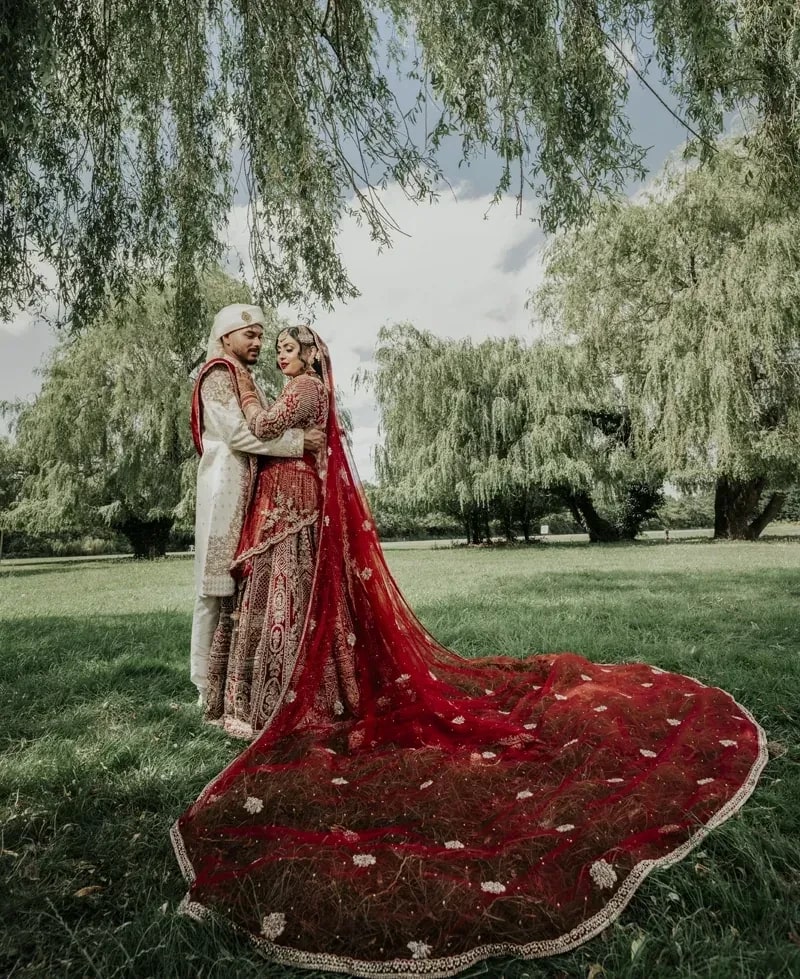
Gaye Holud
Filming Gaye Holud since 2000, now for Bengali families across the United States.
The work
Every wedding we film is shot, cut and graded in house, no sub-contracted crews, no stock transitions.
The Bengali wedding
At a Bengali wedding, the most memorable footage often has little to do with the couple. It belongs to the aunts. On the Gaye Holud morning, the married women of the family cover the bride and groom in turmeric, sing the traditional songs and send them toward married life. Nobody is posing, and nobody should be asked to.
We plan the Holud the way a documentary crew would. There are enough of us to cover the bride's side and the groom's side at the same time, and we know to film the singing and the mess as they unfold rather than tidying the scene for a photograph.
Order of service
The Gaye Holud
Turmeric everywhere, and nobody standing still.
- Where
- Traditionally the bride's home, with a separate celebration at the groom's. In the US it is also held in hotel event rooms and banquet halls, sometimes only hours before the main ceremony.
- How long
- 1.5–3 hours
- 01
The gathering
The married women arrive and the songs start. We are in the room before them, getting a feel for the space and finding the aunts who will carry the morning.
- 02
Applying the haldi
হলুদThe binding momentThe married women rub turmeric paste onto the bride's face, arms, hands and feet, each adding a blessing as she goes. It is close, messy and full of affection, and it is the heart of the film.
- 03
Tatva
Gifts are presented to the bride: saris, sweets, oils and, in many families, a decorated fish seen as a sign of good fortune. We film the giving and the reactions rather than an inventory of what was given.
- 04
The bathing ritual
The bride is cleansed with water brought by the women of the family. It is private by nature, and we film only as much as the family is comfortable with, after asking.
- 05
The groom's Holud
On the groom's side, married women apply his turmeric, usually with more teasing and with younger brothers and cousins joining in. A second operator covers it so both families appear in the film.
Where Gaye Holud fits
It is the final ritual before the wedding itself, and it often runs on a tight schedule.
- the days before
Pre-wedding events
Mehndi and family gatherings set the tone for the weekend.
- wedding morning, or the day before
Gaye Holud
Turmeric at both families' homes, or in a hotel event room. Often the warmest stretch of the film.
- same afternoon or next day
The main ceremony
The Bengali wedding itself. When it follows the Holud on the same day, the morning has very little slack.
- the following day
Bou Bhaat
The reception hosted by the groom's family to welcome the bride.
Twenty-five years in the room
What we get right
The difference between documenting a ritual and simply recording chaos.
We film the aunts
The strongest moments at a Gaye Holud come from the married women: the songs, the turmeric, the jokes at the bride's expense. We cover the morning as a portrait of them, because that is where the story lives.
We know who carries the haldi
The turmeric is applied by married women, and each one gives a blessing with it. Knowing who belongs in frame, and when, is what keeps the coverage faithful to the tradition.
We staff both sides of one tight morning
The bride's and groom's Holud often happen at the same time in different places, sometimes just before the main ceremony. A second operator means neither side is rushed or skipped.
We ask before private moments
Some parts of the morning are private. Before the day, the family and our team decide together what is filmed and what is left alone, and our team dresses for turmeric, which stains whatever it touches.
Questions
Before you ask.
Is the Gaye Holud the wedding ceremony?
No. The Holud comes before the wedding, usually that morning or the day before, when the married women of the family cover the bride and groom in turmeric. Few parts of a Bengali wedding are warmer, which is why it deserves full coverage.
Can you film both the bride's and the groom's Holud?
Yes. They often take place at the same time in separate locations, so we assign a second operator to the groom's side and neither celebration is shortchanged.
Our Holud is right before the ceremony. Can you keep to that schedule?
A compressed morning is normal for a Gaye Holud and goes into our plan from the start. We get there early, know which moments matter most, and move quickly and quietly so the afternoon is not delayed.
Will you record the singing?
Yes. Without its songs a Holud loses much of its character, so we record them as part of the film's soundtrack rather than leaving them as background noise. We check with the family before recording where it matters.
Do you cover the whole Bengali wedding weekend?
Yes. We film the Holud, the wedding ceremony and the Bou Bhaat, then edit them into a single film. Whether your ceremony follows Hindu or Muslim custom, we confirm the order of events with your family and officiant beforehand.
Inquire
Is your datestill free?
Share your date, city and number of event days. Within one business day (Eastern Time) we will confirm availability and send a team size and an itemized quote for your Bengali wedding film.